Cultural historian Bob Batchelor launches Brand Strategy and Advertising, a podcast tracing 125 years of advertising history to the brand strategies shaping culture today. Batchelor teaches at Coastal Carolina University and has written 16 books, in addition to being a longtime Marketing and Communications executive.
Read more30% OFF AT BLOOMSBURY WEBSITE -- 2025 HOLIDAY SALE
Stan Lee: A Life for just $11.86 at Bloomsbury.com
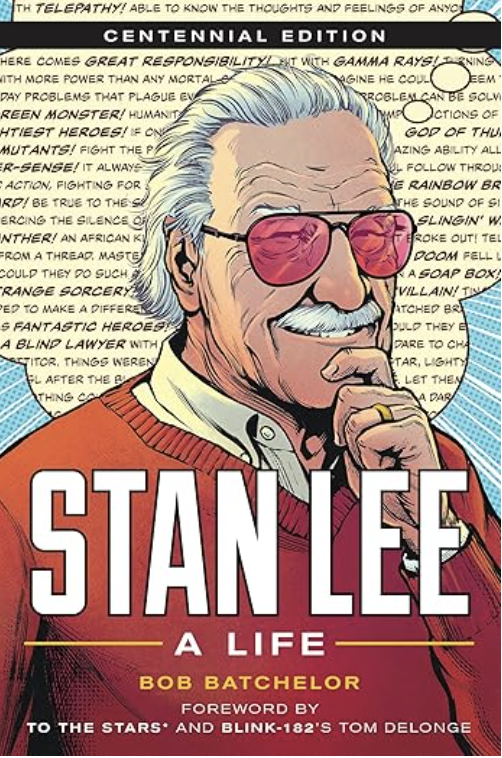
Stan Lee: A Life by award-winning cultural historian Bob Batchelor
“Fascinating…Great work!” — Max Foizey, “Max on Movies,” The Big 550 KTRS, St. Louis
Stan Lee: A Life traces the icon’s journey from Depression-era New York to his reinvention as Marvel’s tireless ambassador, exploring his creative breakthroughs within the currents of American history and media.
“Respectful, well-sourced … may be the best of the bunch.” – Booklist
“Exceptionally well written…an extraordinary biography.” – Midwest Book Review
In Stan Lee: A Life, Batchelor explores how Lee and his collaborators transformed comics through serialized storytelling, moral complexity, and a humanized superhero—innovations that later powered the Marvel Cinematic Universe and cemented Lee’s status as a cross-media icon.
STAN LEE ENTERS THE COMIC BOOK INDUSTRY
A Little Mystery and Uncertainty Surround Young Stan’s Job at Timely Comics
Many episodes in Stanley Lieber’s early life are shrouded in uncertainty. How the teenager bounded from Clinton High School to Joe Simon and Jack Kirby’s assistant at Timely Comics involves both a bit of mystery and a touch of mythmaking.
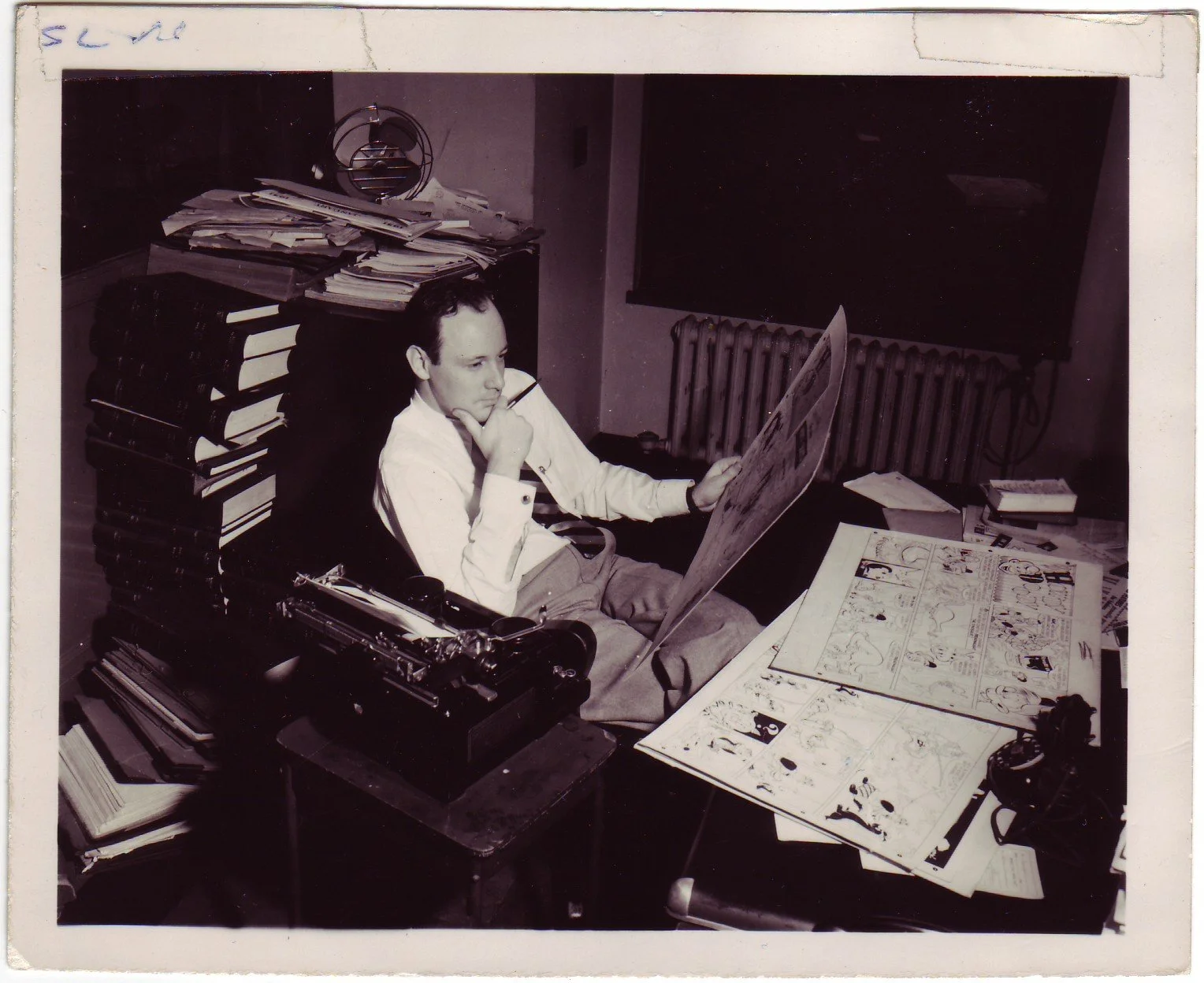
Courtesy of Stan Lee Papers, Collection Number 8302, American Heritage Center, University of Wyoming.
There are several versions of his Timely Comics origin story. One account begins with his mother Celia. Clearly she put her hopes in her oldest son, particularly since her faith in her husband nearly led the family to ruin. Here we have Celia telling Stanley about a job opening at a publishing company where her brother Robbie worked. Without delay, the young high school grad shows up at the McGraw-Hill building on West 42nd Street, but knows little about the company or comic books.
With Robbie’s prodding, Simon explains the business and how comic books are made. He then offers the teen a job. Basically, he and Kirby are so frantic and overworked, particularly with their new hit Captain America, that they just need someone (anyone, really) to provide an extra set of hands.
Robbie Solomon is also at the center of a different account (here the main player), essentially a conduit between Simon and Timely owner Martin Goodman. In addition to being Celia Lieber’s brother, Robbie married the publisher’s sister Sylvia. Goodman surrounded himself with family members, despite the imperious tone he took with everyone who worked for him. Receiving Robbie’s stamp of approval (and the familial tie) made the boy’s hire fait accompli. Simon, then, despite what he may or may not have thought of the boy, basically had to take Leiber on. “His entire publishing empire was a family business,” explained historians Blake Bell and Michael J. Vassallo.[i] Solomon had a strange job – a kind of in-house spy who ratted out employees not working hard enough or playing fast and loose with company rules.
While the family connection tale is credible and plays into the general narrative of Goodman’s extensive nepotism, Lee offered a different perspective, making it more of a coincidence. “I was fresh out of high school,” he recalled, “I wanted to get into the publishing business, if I could.” Rather than being led by Robbie, Lee explained: “There was an ad in the paper that said, ‘Assistant Wanted in a Publishing House.’”[ii] This alternative version calls into question Lee’s early move into publishing – and throwing up for grabs the date as either 1940, which is usually listed as the year of his hiring, or 1939, as he later implied.[iii]
Lieber may have not known much about comic books, but he recognized publishing as a viable option for someone with his skills. He knew that he could write, but had no way of really gauging his creative talents. Although Goodman was a cousin by marriage, he did not have much interaction with his younger relative, so it wasn’t as if Goodman purposely brought Lieber into the firm. No one will ever really know how much of a wink and nod Solomon gave Simon or if Goodman even knew about the hiring, though the kid remembered the publisher being surprised the first time he saw him in the building.
The teen, though bright, talented, and hard working, needed a break. His early tenure at Timely Comics served as a kind of extended apprenticeship or on-the-job training at comic book university. Lieber was earnest in learning from Simon and Kirby as they scrambled to create content. Since they were known for working fast, the teen witnessed firsthand how two of the industry’s greatest talents functioned. The lessons he learned set the foundation for his own career as a writer and editor, as well as a manager of talented individuals.

By Marvel Comics/Marvel Entertainment.The original uploader was Iftekharahmed96 at English Wikipedia..Later version(s) were uploaded by DatBot at en.wikipedia. - Transferred from en.wikipedia to Commons.(Original text : http://marvel-microheroes.wikia.com/wiki/File:Timely_Comics_logo.png), Public Domain, https://commons.wikimedia.org/w/index.php?curid=132830648
NOTES
[i] Blake Bell and Michael J. Vassallo, The Secret History of Marvel Comics: Jack Kirby and the Moonlighting Artists at Martin Goodman’s Empire (Seattle: Fantagraphics, 2013), 98.
[ii] Stan Lee interview, “Interview with Stan Lee (Part 1 of 5),” IGN, June 26, 2000, http://www.ign.com/articles/2000/06/26/interview-with-stan-lee-part-1-of-5 (accessed June 1, 2016).
[iii] Lieber’s hiring date never been conclusive. In an unpublished draft of the history of Marvel, Lee wrote “early 1940,” but other publications and places he says or infers 1939. Lee, “History of Marvel (Chapters 1, 2, 3),” Unpublished, 1. Marvel Comics -- History (Draft of “History of Marvel Comics”) 1990 Box 5 Folder 7, Stan Lee Papers.
THE GREAT GATSBY IN THE HEADLINES -- $2.99 SALE ON THE GATSBY CODE
The Gatsby Code eBook just $2.99
When The Great Gatsby surges back into the news, we are reminded once again that America’s most shimmering and elusive novel still haunts the culture—class, ambition, desire, the fragile scaffolding of the American dream.

The Gatsby Code: A Century of Dreams and Disillusion by award-winning cultural historian Bob Batchelor
To celebrate the conversation (and help more readers join it), Tudor City Books has dropped the price of eBook to $2.99 on Amazon for a limited time.
If you’ve been meaning to revisit Gatsby’s world—or explore why the novel keeps gripping us a century on—now’s the moment. More than just a literary analysis or criticism, The Gatsby Code is a century-spanning cultural biography of a novel and its enigmatic protagonist. From Gatsby’s humble roots as James Gatz in North Dakota to his glittering rise and tragic fall in West Egg, Bob Batchelor decodes the psychological and sociological layers of Fitzgerald’s antihero and the America he both embraced and exposed.
Bob Batchelor has written a powerful study of The Great Gatsby and its ability to resist the erosion and forgetfulness of time...and discovers a Gatsby we had never seen before—wounded and alone. — Jerome Charyn, author of Maria La Divina, a novel of Maria Callas
Bottom line: Gatsby’s back in the conversation—jump in while the eBook is just $2.99. Get the The Gatsby Code eBook today!
Also in Book News: Stan Lee: A Life (Paperback) Out in Time for the Holidays!
Bloomsbury Academic has released the paperback, Expanded Centennial Edition of Stan Lee: A Life—a full portrait of Marvel’s tireless ambassador from Depression-era New York to global icon. Early praise called it “respectful, well-sourced…may be the best of the bunch” (Booklist) and “exceptionally well written…an extraordinary biography” (Midwest Book Review).

Stan Lee: A Life by Bob Batchelor, Foreword by Blink-182 and To The Stars* icon Tom DeLonge
Paperback details: 264 pages • ISBN-13: 979-8881808860 • List: $16.95
Order & save: Use code GLR BD8 at Bloomsbury.com for 20% off.
About Bob Batchelor
I write about the people and stories that shape American culture—icons who cross generations and mediums. I’ve published 16 books (and edited 19) on subjects ranging from The Great Gatsby and Mad Men to Jim Morrison and Prohibition kingpin George Remus. My work has appeared in or been featured by the New York Times, BBC, Los Angeles Times, The Guardian, PBS, and NPR. I’m an Assistant Professor of Communication, Media, & Culture at Coastal Carolina University. More at bobbatchelor.com.
BOB BATCHELOR’S STAN LEE: A LIFE ARRIVES IN PAPERBACK
Stan Lee’s extraordinary life was as epic as the superheroes he created, from the Amazing Spider-Man to the Mighty Avengers. His ideas and one-of-a-kind voice and image are at the heart of global culture, loved by millions of fans across the globe.
Bloomsbury Academic will release the paperback of Stan Lee: A Life by award-winning cultural historian Bob Batchelor on October 30, 2025. Hailed as the “definitive” biography of Marvel’s iconic creator and leader, the book offers a full portrait of Lee’s remarkable, nine-decade career and global impact.
REPLAY ON-DEMAND -- "WRITE YOUR BOOK" WITH DONALD THOMPSON & BOB BATCHELOR
Get Your Book Project Started (or Finished) with Help From Experts!
Watch the on-demand replay of “Write Your Book,” which outlines the steps from brainstorming through publication.
For more information, check out the conversation I had with EY Entrepreneur of the Year honoree Donald Thompson. Then, see the recent livestream we recorded at https://youtu.be/tGiNRqWGh4Q?si=1wOaFvbLm4dV2KBe

We share expert insights for leaders, entrepreneurs, and executives ready to turn their ideas into a published book. Whether you’re starting with a spark of inspiration or a rough outline, you’ll gain practical advice, motivation, and the tools you need to take the first step toward authorship.
AUTHORITY ISN'T CLAIMED...IT IS AUTHORED
In a visibility-first economy, authorship is the fastest path to durable authority. Slides expire and posts evaporate, but a book endures—codifying your point of view, sharpening your leadership brand, and traveling into rooms you haven’t entered yet. Writing forces strategic clarity: What problem do you solve, for whom, and why now? That discipline becomes the spine of your thought-leadership platform and aligns message, market, and milestones.
A book also operationalizes influence. Chapters become reusable assets for keynotes, bylined articles, media appearances, investor narratives, and recruiting content—the content vault you draw from for years. Pair authorship with an intentional platform (owned media, selective PR, webinars, executive social) and you improve discoverability across search engines, AI summaries, and human gatekeepers. Measure it like any growth initiative: influenced pipeline quality, speaking demand, media velocity, share of voice on priority themes, inbound board seat interest, and hiring lift.
Common objections—time, writing skill, fear of the blank page—are solvable with a professional editorial team. The real risk is silence: letting competitors and algorithms define your story. Build the book once; scale your authority indefinitely. For executives intent on commanding a category and shaping what’s next, authorship isn’t a vanity play—it’s the operating system of your influence.
Read moreWRITING TIPS TO BEGIN YOUR BOOK JOURNEY
Every author’s journey begins the same way: with a blank page and a glimmer of an idea. For aspiring nonfiction writers—and anyone who feels the tug of a story inside them—the hardest part is often starting. Whether you are a pop culture aficionado, would-be biographer, or someone drawn to capturing history, there is no perfect moment to begin your book.
You just start.
My own writing journey began in a high school newsroom, writing columns and dreaming of the bylines I might someday see in glossy magazines. I came of age in a college town (Slippery Rock, PA, home of Slippery Rock University) where professors and ideas swirled around me. Writing felt aspirational. A cherished teacher—Martha Campbell—rewarded my hard work with a sports column featuring my work: “Batchelor’s Bench.” I loved writing that column and holding our small high school newspaper in my hands.
As a college student, I sent essays to publications that were way out of my league. The rejections piled up, but the process enabled me to slowly build confidence with each reply—published or not. Every so often, there would be a kind note or something that looked like more than a stamped “rejection.” Those were glorious days!
About a decade later, by the time I wrote The 1900s (Greenwood, 2002), I approached it from a researcher’s mindset. I had yet to fully develop my narrative voice, let alone the courage to let it rise on the page. The 1900s, though, served as a foundation: meticulous research, structural discipline, and an unwavering commitment to learning during the writing process.

Photo by Aneta Pawlik on Unsplash
If you’re just beginning your book journey, here are five essential tips drawn from my own experience:
1. Establish a Writing Rhythm That Works for You
Life is demanding. Your writing process should complement—not fight—your daily responsibilities. Consistency, not volume, builds momentum. Even 20 minutes a day adds up.
2. Start with a Strong Outline
Before I write a word, I create a detailed Table of Contents. For nonfiction, this map is critical. Think deeply about how you plan to open each chapter—those first lines carry a lot of weight.
3. Don’t Believe in Writer’s Block
Writing is work. Work requires discipline. When I feel creative fatigue, I don’t panic. Instead, I switch gears. Reading for pleasure, often on my Kindle, lets me absorb ideas passively and recharges my creative energy.
4. Let Your Curiosity Drive the Research
Even after I have started writing, I keep researching. Every new detail might unlock a better sentence, a sharper insight, or a deeper connection. Curiosity is your most sustainable writing fuel.
5. Experiment with Storytelling Techniques
In The Bourbon King, I explored a postmodern style in one chapter to capture the extravagance of George Remus’ legendary New Year’s Eve party. Creative nonfiction allows room for innovation…even in history-heavy narratives.

The Bourbon King by cultural historian Bob Batchelor
Most importantly, allow yourself time to grow. The voice you find in your first book might surprise you. It should.
To support your own writing journey, keep reading widely and learning from others. Books like The Bourbon King or Stan Lee: A Life can be models—narrative-driven nonfiction that brings culture, history, and people to vivid life. You can find these and other inspiring reads on Amazon and even save a bit with these offers.

Stan Lee: A Life by Bob Batchelor
So what are you waiting for? Open that document. Name your project.
Take the first step. Your book is waiting.
I use Amazon affiliate links on this site—mainly links to books or other cool things. And if you buy via my links, it supports the site with no extra cost to you. This is a contributed post and may contain affiliate links. I was compensated for this post, but reviewed it and regard the article as a natural fit for my readers.
THE GATSBY CODE: A CENTURY OF DREAMS AND DISILLUSION -- PRE-ORDER EBOOK
In The Gatsby Code, cultural historian Bob Batchelor—award-winning author of acclaimed biographies and expert on American mythmaking—offers a masterful deep dive into one of literature’s most enduring icons: Jay Gatsby. As The Great Gatsby turns 100, Batchelor delivers a revelatory chronicle of the novel’s past, present, and future impact, weaving cultural history, literary analysis, and philosophical inquiry into a riveting exploration of why Gatsby still matters.
Read more3 REASONS YOUNG PROFESSIONALS SHOULD READ THE AUTHENTIC LEADER

The workplace is undergoing constant change. As a result, young professionals are stepping into roles that demand adaptability, resilience, and a strong sense of purpose. This type of people-first leadership is at the heart of authentic leadership.
The Authentic Leader: The Power of Deep Leadership in Work and Life is a guide for anyone who aspires to lead with integrity and impact, no matter what stage they are at in their career stage. Here’s why young professionals should read this book and the lessons they’ll take away.
1. Leadership Starts Before the Title
Many young professionals assume leadership begins with a promotion, but The Authentic Leader teaches that leadership is a mindset, not a job title. Leadership starts with self-awareness, responsibility, and the ability to positively influence others—whether you’re managing a team or contributing as an individual.
Lesson Learned: Great leaders take ownership of their work, build trust, and inspire those around them long before they reach the executive suite. By embracing leadership principles early, young professionals set themselves apart and create additional opportunities for growth.
2. Authenticity Builds Long-Term Success
In a world that rewards personal branding and social media presence, it is easy to fall into the trap of trying to be who you think others want you to be. The Authentic Leader emphasizes that real success comes from being authentic, aligning your values with your work, and building trust through transparency.
Lesson Learned: The strongest leaders—now and throughout history—have been those who remain true to their values, communicate honestly, and foster real connections. Young professionals who develop these habits early will build lasting credibility and meaningful careers.
3. Emotional Intelligence is the Key to Influence
The workplace is filled with diverse perspectives, challenges, and moments of uncertainty. The Authentic Leader highlights the power of emotional intelligence in navigating relationships, resolving conflicts, and creating positive workplace cultures.
Lesson Learned: Young professionals who practice empathy, active listening, and emotional self-awareness will be better equipped to collaborate, lead, and create a lasting impact in their industries.
Final Thought
Leadership isn’t something you wait for over days, months, and years. It is your responsibility to develop the necessary skills every day. The Authentic Leader provides the tools and insights young professionals need to become confident, purpose-driven leaders in a fast-changing world. By understanding these principles early, they can build careers that are not only successful, but also deeply fulfilling.
Are you ready to take the first step toward authentic leadership? Pick up The Authentic Leader and start shaping your leadership journey today.

The Authentic Leader by Bob Batchelor
Quisque iaculis facilisis lacinia. Mauris euismod pellentesque tellus sit amet mollis.