A Little Mystery and Uncertainty Surround Young Stan’s Job at Timely Comics
Many episodes in Stanley Lieber’s early life are shrouded in uncertainty. How the teenager bounded from Clinton High School to Joe Simon and Jack Kirby’s assistant at Timely Comics involves both a bit of mystery and a touch of mythmaking.
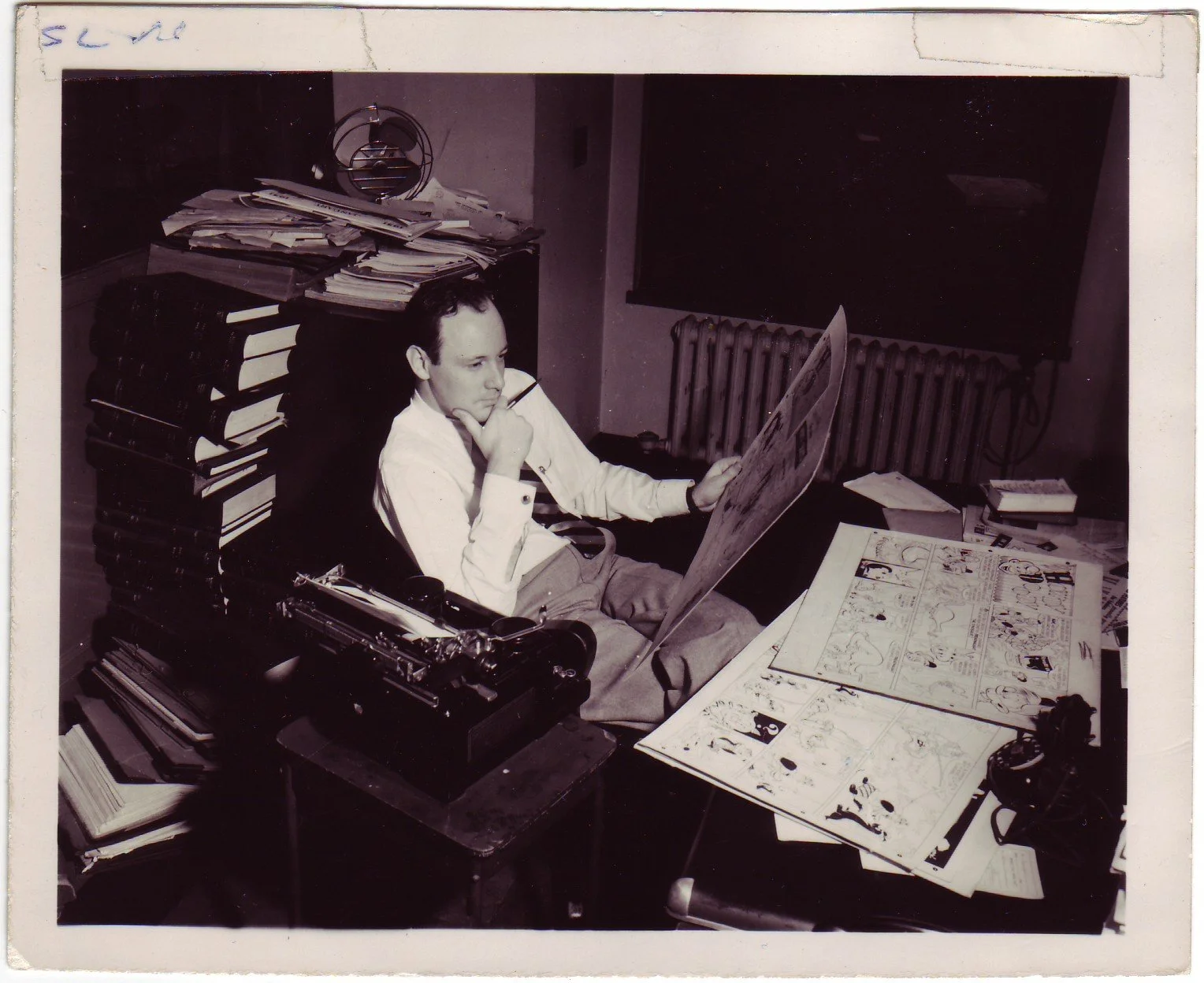
Courtesy of Stan Lee Papers, Collection Number 8302, American Heritage Center, University of Wyoming.
There are several versions of his Timely Comics origin story. One account begins with his mother Celia. Clearly she put her hopes in her oldest son, particularly since her faith in her husband nearly led the family to ruin. Here we have Celia telling Stanley about a job opening at a publishing company where her brother Robbie worked. Without delay, the young high school grad shows up at the McGraw-Hill building on West 42nd Street, but knows little about the company or comic books.
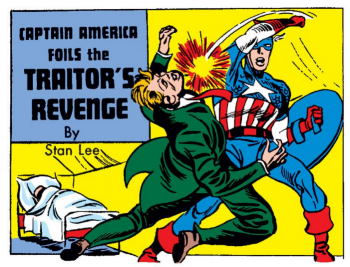
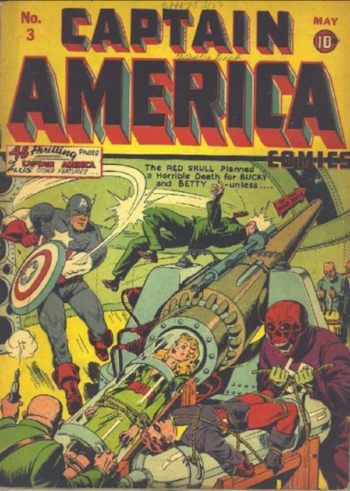
With Robbie’s prodding, Simon explains the business and how comic books are made. He then offers the teen a job. Basically, he and Kirby are so frantic and overworked, particularly with their new hit Captain America, that they just need someone (anyone, really) to provide an extra set of hands.
Robbie Solomon is also at the center of a different account (here the main player), essentially a conduit between Simon and Timely owner Martin Goodman. In addition to being Celia Lieber’s brother, Robbie married the publisher’s sister Sylvia. Goodman surrounded himself with family members, despite the imperious tone he took with everyone who worked for him. Receiving Robbie’s stamp of approval (and the familial tie) made the boy’s hire fait accompli. Simon, then, despite what he may or may not have thought of the boy, basically had to take Leiber on. “His entire publishing empire was a family business,” explained historians Blake Bell and Michael J. Vassallo.[i] Solomon had a strange job – a kind of in-house spy who ratted out employees not working hard enough or playing fast and loose with company rules.
While the family connection tale is credible and plays into the general narrative of Goodman’s extensive nepotism, Lee offered a different perspective, making it more of a coincidence. “I was fresh out of high school,” he recalled, “I wanted to get into the publishing business, if I could.” Rather than being led by Robbie, Lee explained: “There was an ad in the paper that said, ‘Assistant Wanted in a Publishing House.’”[ii] This alternative version calls into question Lee’s early move into publishing – and throwing up for grabs the date as either 1940, which is usually listed as the year of his hiring, or 1939, as he later implied.[iii]
Lieber may have not known much about comic books, but he recognized publishing as a viable option for someone with his skills. He knew that he could write, but had no way of really gauging his creative talents. Although Goodman was a cousin by marriage, he did not have much interaction with his younger relative, so it wasn’t as if Goodman purposely brought Lieber into the firm. No one will ever really know how much of a wink and nod Solomon gave Simon or if Goodman even knew about the hiring, though the kid remembered the publisher being surprised the first time he saw him in the building.
The teen, though bright, talented, and hard working, needed a break. His early tenure at Timely Comics served as a kind of extended apprenticeship or on-the-job training at comic book university. Lieber was earnest in learning from Simon and Kirby as they scrambled to create content. Since they were known for working fast, the teen witnessed firsthand how two of the industry’s greatest talents functioned. The lessons he learned set the foundation for his own career as a writer and editor, as well as a manager of talented individuals.

By Marvel Comics/Marvel Entertainment.The original uploader was Iftekharahmed96 at English Wikipedia..Later version(s) were uploaded by DatBot at en.wikipedia. - Transferred from en.wikipedia to Commons.(Original text : http://marvel-microheroes.wikia.com/wiki/File:Timely_Comics_logo.png), Public Domain, https://commons.wikimedia.org/w/index.php?curid=132830648
NOTES
[i] Blake Bell and Michael J. Vassallo, The Secret History of Marvel Comics: Jack Kirby and the Moonlighting Artists at Martin Goodman’s Empire (Seattle: Fantagraphics, 2013), 98.
[ii] Stan Lee interview, “Interview with Stan Lee (Part 1 of 5),” IGN, June 26, 2000, http://www.ign.com/articles/2000/06/26/interview-with-stan-lee-part-1-of-5 (accessed June 1, 2016).
[iii] Lieber’s hiring date never been conclusive. In an unpublished draft of the history of Marvel, Lee wrote “early 1940,” but other publications and places he says or infers 1939. Lee, “History of Marvel (Chapters 1, 2, 3),” Unpublished, 1. Marvel Comics -- History (Draft of “History of Marvel Comics”) 1990 Box 5 Folder 7, Stan Lee Papers.
Quisque iaculis facilisis lacinia. Mauris euismod pellentesque tellus sit amet mollis.