Introducing Brand Strategy and Advertising: A Podcast 125 Years in the Making
Every semester, I walk into a classroom — or, these days, open an online course — and ask students a version of the same question: when was the last time an ad made you feel something?
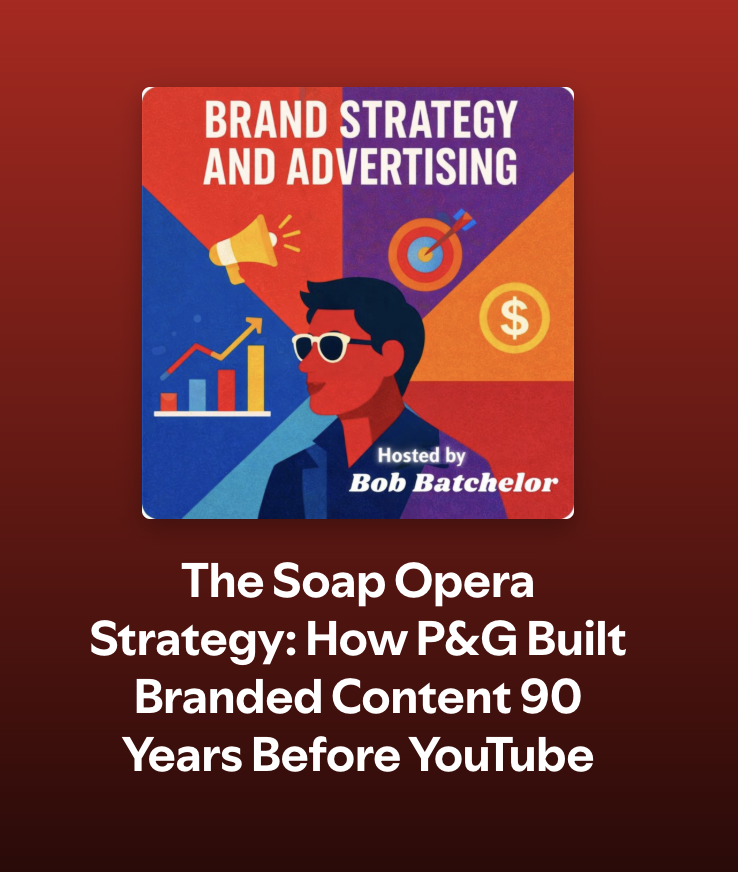
The latest episode of Brand Strategy & Advertising, which examines the role P&G played in advertising history
Not notice.
Not tolerate.
Feel.
Perhaps a commercial that hit you before you could name what it was selling or a slogan that lodged somewhere in your brain and hasn’t left in twenty years. What about a brand that made you want to belong to something?
The room gets quiet. Then people start to register and the discussion begins…
That moment — the pause before the hands — is why I made this podcast.
The Idea That Wouldn’t Leave Me Alone
I’ve spent the better part of thirty years at the intersection of American history, pop culture, and brand strategy. I’ve written books about Stan Lee and the Marvel universe, Jim Morrison and the Doors, George Remus and the Prohibition underworld, Kimberly-Clark and the consumer revolution. I’ve edited three volumes on how advertising shaped American life. I’ve taught brand strategy for two decades.
And the thing I kept running into — in every book, every course, every conversation with students and professionals — is that most people have no idea how advertising actually works. Not in the surface sense of “this commercial is trying to sell me something.” Rather, in the deeper sense: how advertising manufactured American desire from the ground up, built the consumer culture we live inside, and made brands powerful enough to survive wars, recessions, and the complete reinvention of media.
There are excellent academic books on this. I’ve edited some of them. But there was no show that did what I wanted to do: connect 125 years of advertising history to the brand strategies operating right now, in plain language, in episodes you can finish on a commute.
So I built it.
What Brand Strategy and Advertising Actually Is
The show is called Brand Strategy and Advertising, and it’s a podcast about the history of advertising in America — from patent medicines and the first national magazine campaigns to P&G’s invention of branded content, Bill Bernbach’s creative revolution, the birth of brand positioning in the 1970s, and the digital disruption that rewired everything in the last two decades.
Each episode runs 12 to 15 minutes. Long enough to go deep. Short enough to be useful.
The structure is simple: every episode takes a historical moment — a campaign, a figure, a strategic shift — and traces its direct line to something you encounter in contemporary brand strategy. Because here’s what decades of research have taught me: the fundamental logic of advertising has changed remarkably little. The channels change. The scale changes. The speed changes. But the core mechanisms — how brands manufacture desire, build equity, and occupy mental positions in the consumer’s mind — were largely figured out before television existed.
“The best advertising history isn’t nostalgia. It’s a user’s manual for the present.”
That’s the thesis. I believe it completely.
Who This Podcast Is For
The honest answer: anyone curious about how culture gets made.
The more specific answer: if you work in marketing, advertising, communications, or brand strategy, this show will give you context and vocabulary that most practitioners never acquire because they came up in the industry rather than through the history. If you’re a student studying communications, media, or business, this is the background reading that makes your courses click. If you’re a cultural historian or just someone who has ever wondered why certain brands feel like part of your identity, this show is for you too.
I’ve tried to write and record it so that a sophomore who has never taken a marketing class and a brand director with twenty years of experience can both find it valuable. That’s a harder needle to thread than it sounds. I think we got there.
What’s in the First Episodes
Here’s a taste of where we start:
Episode 1: An Introduction: We’re studying 125 years of advertising history to decode contemporary brand strategy. Each episode connects historical case studies—drawn from the three-volume anthology We Are What We Sell: How Advertising Shapes American Life—to current brand practice.
Episode 2: Discover the three major forces that made advertising the heart of consumer capitalism between 1930-1975: how consumption became identity, how every new technology gets weaponized for selling, and how advertising became art.
Episode 3: A deep dive into the hidden strategy behind visual brand identity that most marketers miss. You'll discover why some brands succeed with cartoon mascots, while others fail, why consistency beats cleverness, and what the Michelin Man can teach you about building brands in 2025.
Episode 4: We examine why every economic crisis since the 1930s follows the same predictable pattern, and why understanding Depression-era advertising makes you better at analyzing brands in any economy.
Episode 5: Soap operas, Irna Phillips, and the woman who invented modern television — then nearly lost everything to a brand that decided it could write the rules.
► Listen on Spotify [Spotify link]
► Listen on Apple Podcasts [Apple Podcasts link]
The Larger Argument
I want to say something that might sound counterintuitive for a show about advertising: I didn’t build this as a celebration.
Advertising is one of the most powerful forces in American cultural history. It built the consumer economy, created the brands that feel like part of the national identity, gave us some of the most memorable art and language of the last century. Advertising has also manufactured discontent, telling people something was wrong with them and then sold them the solution. It edited culture through what it was willing to sponsor and what it wasn’t. Advertising has always been, at its core, in the business of manufacturing desire.
A show about advertising history that ignores that isn’t honest. So this one doesn’t.
My goal is for listeners to come away understanding both sides: the craft and the intelligence of the best advertising work, and the structural logic underneath it that brand strategists need to understand whether they find it inspiring or troubling. Both things can be true. In my experience, the people who are best at this work are the ones who hold both.
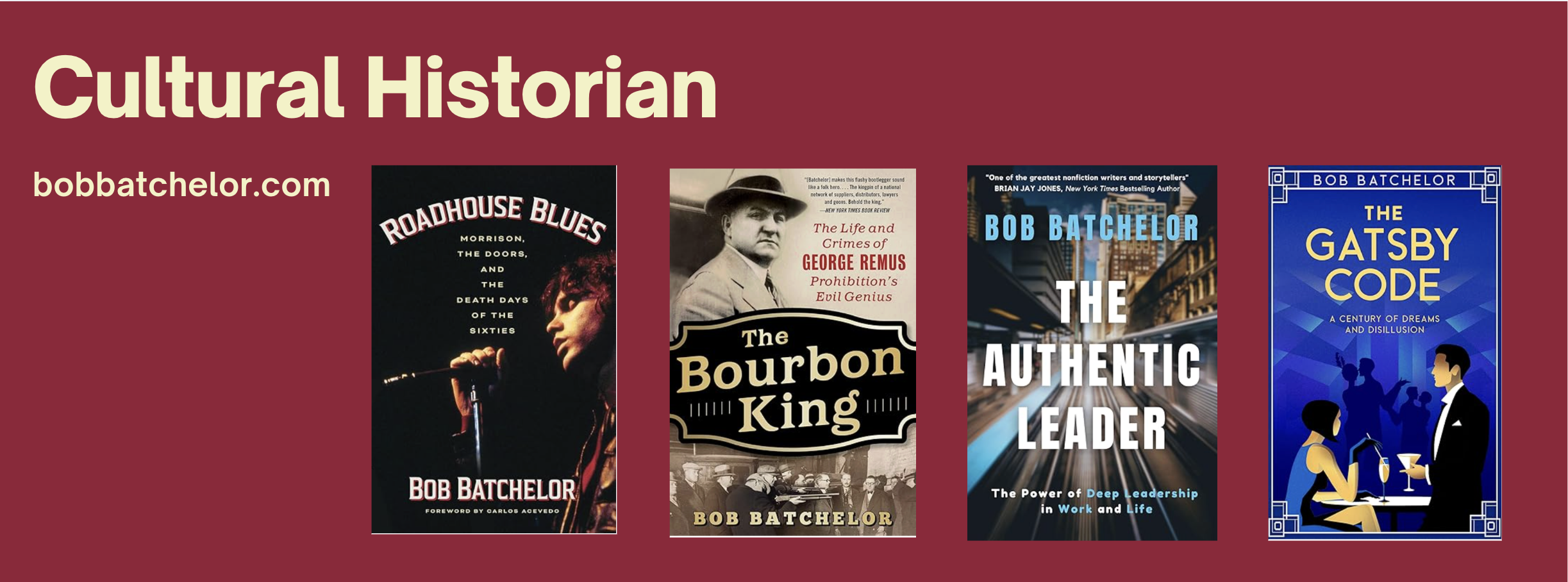
Some of the books authored by cultural historian and Coastal Carolina University Assistant Professor Bob Batchelor
A Little About Where This Comes From
I’m a cultural historian and professor at Coastal Carolina University’s Department of Communication, Media, and Culture. I’ve written or edited more than two dozen books, including Stan Lee: A Life, Roadhouse Blues: Morrison, the Doors, and the Death Days of the Sixties, The Bourbon King: The Life and Crimes of George Remus, and Kotex, Kleenex, Huggies: Kimberly-Clark and the Consumer Revolution in American Business. I co-edited the three-volume We Are What We Sell: How Advertising Shapes American Life… And Always Has, which serves as the primary backbone for this podcast.
My work has appeared in the New York Times, Los Angeles Times, PopMatters, and Time. I’ve been a commentator for NPR, BBC, PBS NewsHour, and the National Geographic Channel.
I also ran marketing and communications at the executive level in corporate America before returning to university teaching. Which means when I talk about brand strategy, I’m talking about work I’ve done, not just work I’ve studied.
One Last Thing
The question I started with — when was the last time an ad made you feel something — is also the question the best brand strategists ask every single day. It’s the professional version of a much older question: what makes people care?
That question has a 125-year answer. This podcast is how I’ve tried to tell it.
New episodes drop regularly. Subscribe on Spotify or Apple Podcasts, and if you find it useful, share it with someone who teaches, studies, or works in the field. That’s the only algorithm that actually matters.
► Subscribe on Spotify [Spotify link]
► Subscribe on Apple Podcasts [Apple Podcasts link]
