Stan's First Team-Up: Stan Lee and Artist Joe Maneely

Sketch of Stan Lee fiddling with artwork by Joe Maneely -- courtesy of Stan Lee Papers, Collection Number 8302, American Heritage Center, University of Wyoming

Sketch of Stan Lee fiddling with artwork by Joe Maneely -- courtesy of Stan Lee Papers, Collection Number 8302, American Heritage Center, University of Wyoming

History if full of "what if" moments.

Comic book history changed forever the early hours of June 7, 1958, when artist Joe Maneely fell between moving commuter railway cars on the way to his New Jersey home.

Maneely and Stan Lee were close friends and artistic teammates at Atlas Comics, the name publisher Martin Goodman used during the 1950s. Lee and Maneely had worked on a syndicated newspaper strip -- Mrs. Lyons' Cubs -- then as Lee's favorite artist to work with, Maneely penciled and inked countless comic book covers and issues. The two shared a common sensibility and manic energy.

The drawing from May 1958, just a little more than a month before the artist's untimely death, captures Lee's spirit and Maneely's reaction to "purple clouds" and "red sidewalks."

The "what if" question for Lee and Maneely would have centered on what role the eminent artist would have had on the superhero genre and Lee's trajectory if he had lived. In interviews, Lee has mentioned that he and Maneely may have gone into partnership and left Goodman's operation.

If Maneely would have survived, perhaps Lee feels less inclined to turn to Jack Kirby and Steve Ditko when the superhero craze caught fire. Maneely's recollection of working with Lee in the 1950s would also provide comic book historians and aficionados insight into the writer/editor's work habits, scripts, and other topics during the extreme challenges the comic book industry faced in the 1950s.

The Maneely sketch is one of many rarely seen treasures at The American Heritage Center (AHC), the unique library and archive at the University of Wyoming in the Western town of Laramie. AHC is the university’s repository of manuscript collections, rare books, and university archives. One of its many fine collections focuses on the Comic Book Industry.

The Comic Book Industry collection is “unique in documenting the editors and writers of this industry increasingly recognized by scholars as having significant impact on the nation’s popular culture.”

One of the most noteworthy collections at AHC is the Stan Lee Papers (others include Private Snafu writer/editor Harold Elk Straubing and Superman editor Mort Weisinger). The Stan Lee collection is a seemingly endless archive of Lee’s work at Marvel, particularly strong in the era from the 1940s to 1970s.

The Stan Lee Papers contain a wide range of documents and items, not just papers, though the archive has box after box of Lee’s business correspondence, fan mail, and Marvel internal memos.

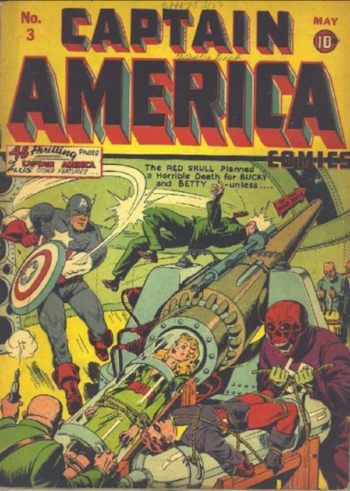
Stan Lee’s First Publication – Captain America Comics #3 (1941)

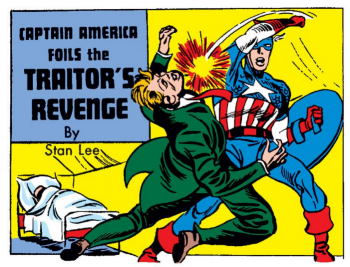
Stan Lee writes Captain America story, first publication for Marvel

Stan Lee writes Captain America story, first publication for Marvel


Joe Simon needed copy and he needed it fast!

The Timely Comics editorial director and his coworker and friend Jack Kirby were hard at work on the hit they had recently launched – the red, white, and blue hero Captain America. Readers loved the character and Simon and Kirby scrambled to meet the demand.

The Captain America duo brought in some freelancers to keep up. Then they threw some odd copy-filler stories to their young apprentice/office boy Stanley Lieber as a kind of test run to see if the kid had any talent. He had been asking to write and the short story would be his on-the-job audition.

The throwaway story that Simon and Kirby had the teenager write for Captain America Comics #3 (May 1941) was titled: “Captain America Foils the Traitor’s Revenge.” The story also launched Lieber’s new identity as “Stan Lee,” the pseudonym he adopted in hopes of saving his real name for the future novel he might write.

Given the publication schedule, the latest the teen could have written the story is around February 1941, but he probably wrote it earlier. The date is important, because it speaks to Lieber’s career development. If he joined the company in late 1939, just after Kirby and Simon and when they were hard at work in developing Captain America, then there probably wasn’t much writing for him to do. However, if the more likely time frame of late 1940 is accepted, then Lieber was put to work as a writer fairly quickly, probably because of the chaos Simon and Kirby faced in prepping issues of Captain America and their other early creations, as well as editing and overseeing the Human Torch and Sub-Mariner efforts.

Lee later acknowledged in his autobiography that the two-page story was just a fill-in so that the comic book could “qualify for the post office’s cheap magazine rate.” He also admitted, “Nobody ever took the time to read them, but I didn’t care. I had become a published author. I was a pro!” Simon appreciated the teen’s enthusiasm and his diligence in attacking the assignment.

An action shot of Captain America knocking a man silly accompanied Lieber’s first publication for Simon and Kirby. The story – essentially two pages of solid text – arrived sandwiched between a Captain America tale about a demonic killer on the loose in Hollywood and another featuring a giant Nazi strongman and another murderer who kills people when dressed up in a butterfly costume. “It gave me a feeling of grandeur,” Lee recalled at the 1975 San Diego Comic-Con.

While many readers may have overlooked the text at the time, its cadence and style is a rough version of the mix of bravado, high-spirited language, and witty wordplay that marked the young man’s writing later in his career.

Lou Haines, the story’s villain, is sufficiently evil, although we never do find out what he did to earn the “traitor” moniker. In typical Lee fashion, the villain snarls at Colonel Stevens, the base commander: “But let me warn you now, you ain’t seen the last of me! I’ll get even somehow. Mark my words, you’ll pay for this!”

In hand-to-hand combat with the evildoer, Captain America lands a crippling blow, just as the reader thinks the hero may be doomed. “No human being could have stood that blow,” the teen wrote. “Haines instantly relaxed his grip and sank to the floor – unconscious!” (Captain America Comics #3, p. 37) The next day when the colonel asked Steve Rogers if he heard anything the night before, Rogers claims that he slept through the hullabaloo. Stevens, Rogers, and sidekick Bucky shared in a hearty laugh.

The “Traitor” story certainly doesn’t exude Lee’s later confidence and knowing wink at the reader, but it clearly demonstrates his blossoming understanding of audience, style, and pace.

Both “Stan Lee” and a career were launched!


Cover of Captain America #3, Stan Lee's first writing credit for Marvel in 1941

Cover of Captain America #3, Stan Lee's first writing credit for Marvel in 1941

Stan Lee's Super Bowl Commercial Cameo

Always popping up in the most unexpected places, Stan Lee pulled off another semi-secret cameo, this one in Honda's Super Bowl ad for its revamped CR-V. Using the tag line: “Chase your dreams!” Honda assembled a group of celebrities, each appearing as a version of their high school selves. Then, using voiceovers, they discuss how the viewer might tackle his or her dreams.

Stan Lee in Honda's new Super Bowl commercial

Stan Lee in Honda's new Super Bowl commercial

Lee's voice-over is based on his role at the center of the creation of the Marvel Universe:

"If you want to make a universe, make a universe!"

Other celebrities in the Honda ad include, among others: Robert Redford, Magic Johnson, Steve Carell, Missy Elliot, and Viola Davis.

If Lee looks exceedingly young in the photo, it is because he graduated from DeWitt Clinton High School in 1939, not yet 17-years old. Since he grew up in the tragic days of the Great Depression, Lee's mother Celia pushed him to skip grades so that he could graduate and enter the workforce.

Soon after graduation, Lee joined Timely Comics. Within a year, the young man became its defacto editor-in-chief (though he didn't use that title) and art director, despite the fact that he was still a teen.

The urge to work and help his family in a time of need explains how the man behind Marvel got his start. The comic book world, and later American popular culture, would never be the same...


Stan Lee Mini-Bust: Collectible at the American Heritage Center, University of Wyoming

The American Heritage Center (AHC) is a unique library and archive at the University of Wyoming in the unique Western town of Laramie. AHC is the university’s repository of manuscript collections, rare books, and university archives. One of its many fine collections focuses on the Comic Book Industry.

The Comic Book Industry collection is “unique in documenting the editors and writers of this industry increasingly recognized by scholars as having significant impact on the nation’s popular culture.”

One of the most noteworthy collections at AHC is the Stan Lee Papers (others include Private Snafu writer/editor Harold Elk Straubing and Superman editor Mort Weisinger). The Stan Lee collection is a seemingly endless archive of Lee’s work at Marvel, particularly strong in the era from the 1940s to 1970s. The Stan Lee Papers contain a wide range of documents and items, not just papers, though the archive has box after box of Lee’s business correspondence, fan mail, and Marvel internal memos. There are countless audio and videotapes, for example, that would take a researcher weeks to examine.

Since most fans and Marvel aficionados will never get the chance to visit AHC, over the next year I will share some of the unique findings I uncovered.

Stan Lee Mini-Bust, Stan Lee Papers, American Heritage Center, University of Wyoming

Stan Lee Mini-Bust, Stan Lee Papers, American Heritage Center, University of Wyoming


The Stan Lee figurine is one of the interesting pieces among the Stan Lee Papers.

According to WizardUniverse.com:

“Bowen Designs immortalizes the father of the Marvel Universe as this 5” tall collector’s bust! Sculpted by the master, Randy Bowen, the Stan Lee Mini-Bust is scaled to the rest of Bowen’s Marvel busts! What can we say, except “Excelsior, True Believers!” Painted and ready to display.

Sculptor Randy Bowen founded Bowen Designs in 1992 and quickly gained fame for his Marvel collectible statues.

The Stan Lee Mini-Bust sold for $45 in January 2003 with only 1,500 available. Some 14 years ago the figurine would have been a great investment. Recently on eBay, the mini-bust ranged from $175 to a signed statuette for $500.

The Year of Stan Lee

Stan Lee is undoubtedly one of the most important creative icons of the last century. His accomplishments are virtually unparalleled in modern popular culture, particularly when examining his entire career (beginning in the late 1930s and carrying through to the present).

Begin making a list of comparable artists and pop culture icons and you may have trouble finding a dozen like Lee over the last 100 years. Working across parts or all of nine decades, Lee’s longevity alone places him in rare air.

Simply gauged: Lee’s influence on popular culture touches most Americans on a daily basis.

Image of the Stan Lee Collectibles Booth at the Cincinnati Comic Expo, September 24, 2016

Image of the Stan Lee Collectibles Booth at the Cincinnati Comic Expo, September 24, 2016

To commemorate Lee and his significance as a contemporary pop culture icon, I am dedicating this blog to chronicling his life, career, successes, and challenges. Beginning with Lee’s 94th birthday on December 28, 2016, and running for at least the following year, I will bring readers highlights from the amazing, stupendous, and MARVEL-ous career of Stan “the Man” Lee.

My hope is that by examining Lee’s incredible life and work that readers will gain a more complete picture, as well as greater insight into why Lee’s career has been so important.

So, as Stan might say: “Excelsior!” Here’s to a fun ride… ‘Nuff said…

Celebrate Stan Lee's 94th Birthday!

December 28 marks Stan Lee's 94th birthday!

Stan Lee at the Cincinnati Comic Expo, September 24, 2016

Stan Lee at the Cincinnati Comic Expo, September 24, 2016

Leave a birthday greeting or message in the comments section or directly on the Facebook link below:

https://www.facebook.com/Happy94StanLee/

On his birthday, I'll forward all comments to Stan in celebration of his career as one of America's most important creative icons!


Who is Don Draper?

An excerpt from Mad Men: A Cultural History (Rowman & Littlefield, 2016) by M. Keith Booker and Bob Batchelor

"What you’re watching with Don is a representation, to me, of American society. He is steeped in sin, haunted by his past, raised by animals, and there is a chance to revolt. And he cannot stop himself.”
            -- Matthew Weiner, 2014

Don Draper is a hero and villain. The things he worships – California, cars, self-worth, movies, lasting accomplishment – symbolize postwar America in an age when the nation’s power seemed unbounded. Draper, too, is a study in paradox, which essentially serves to make him even more profoundly American. In creating this character, Matthew Weiner forces viewers to reflect on Draper’s life and deeds (good and bad) by showing that aspects of him are in us all – a true everyman for the modern world.

The extremes are always just below the surface with Don. He can lose control in an instance. Draper is also capable of deep compassion. There are bouts of terrifying malevolence. Often, his contempt for the shackles of the corporate world and advertising business forces him to flee, as if one more moment at his desk or in a meeting will yank his soul into eternal damnation. Yet, at the same time, his zeal for what he calls, “the work” and the creative spark that wins him fame and fortune rarely wavers. These dualities create a character that exudes everything that is righteous and strong about the American Dream – a kind of Superman in a suit – but one that also typifies the nation’s ugliness. As a result, there is no easy way to answer this chapter’s title question. Instead, the judgment is pieced together by interrogating both the subtle nuance and audacious bluntness Draper embodies.

Similar to other outstanding fictional characters across film, literature, and television, Draper is timeless. He symbolizes our own era, even as he is meant to typify the chaotic 1960s. Yet, he is not simply a televised version of John Updike’s Harry “Rabbit” Angstrom, Don Corleone, Bob Dylan, Sloan Wilson’s man in the gray flannel suit, Saul Bellow’s Augie March, or Batman. He is representative, but also unique, which is at least in part why audiences are so attracted to him, despite his reprehensible traits. Viewers can see “real life” in Don (traits of their family members and friends), but also those drawn out of the fictional world, from suave characters played by Cary Grant to the real or imagined John F. Kennedy.

Draper is a composite of ideas, actions, and impulses that audiences have proven to relish across American popular culture for decades. Like F. Scott Fitzgerald’s Jay Gatsby, for example, Don is mysterious and has difficulty attuning his two lives after assuming a new identity. Physically, Draper projects the “leading man” looks and toughness of Hollywood stars, like real-life icons Clark Gable and Gregory Peck. In playing Don, Jon Hamm flashes the same tough/tender and realist/idealist persona that many of the golden age film actors emanated. The “tough, but sensitive” personality, combined with traditional male beauty, draws viewers to the Draper character, because we feel his quest, the unyielding existential angst. He is reaching for greatness, but lassoed to the here and now, essentially waging warfare between these competing proclivities.

As a character, Don Draper asks audiences to contemplate his fictional life with the impulses and ideas that power the contemporary world: what role does sexism play in modern society, how much alcohol is too much, how do we treat friends and family, how might we interpret our coworkers and bosses, can we outrun the past, is the future bright. There is no doubt that some viewers take pleasure in the bad boy side of Draper’s personality, particularly with booze, cars, women, and cigarettes. As the character both suffers and rejoices over seven seasons, people acquire the context to add value to their own ideas about life, the past, and avenues toward the future. The framework that Weiner created not only makes Draper an important character in television history, but also provides the show with lasting importance.